

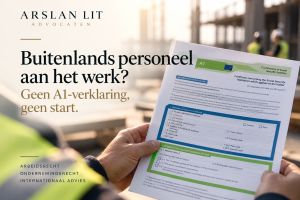
What Employers and Hirers Need to Know
Does your organisation hire foreign workers in the Netherlands through a temporary employment agency, subcontractor or secondment arrangement? If so, the A1 certificate is an important document that should be checked before the workers start their activities in the Netherlands.
Many Dutch companies assume that obtaining an A1 certificate is solely the responsibility of the foreign employer. However, failing to check whether foreign workers have a valid A1 certificate for work in the Netherlands can expose hirers and clients to financial, contractual and legal risks.
What is an A1 certificate?
An A1 certificate establishes which country’s social security legislation applies to an employee who temporarily works in another EU or EEA country or Switzerland.
In the Netherlands, A1 certificates are issued by the Social Insurance Bank (Sociale Verzekeringsbank, SVB). For workers who are posted from another country to the Netherlands, the certificate is generally issued by the competent social security authority in the country from which they are posted.
The A1 certificate confirms that the worker remains subject to the social security legislation of a specific country. Where applicable, the certificate also states the relevant period and conditions.
For Dutch companies hiring foreign personnel, this is important. You want to avoid a situation in which workers at your site are actually subject to Dutch social security legislation, while the required social security contributions have not been paid in the Netherlands.
Why is an A1 certificate important when hiring foreign workers in the Netherlands?
When you hire foreign workers through a foreign supplier, employment agency or subcontractor, you depend to a significant extent on the information and documentation provided by that party.
An A1 certificate issued by the competent authority is binding on the authorities of other Member States for as long as it remains valid and has not been withdrawn or declared invalid by the issuing authority.
A valid A1 certificate therefore provides important evidence regarding the applicable social security system.
Without an A1 certificate, that certainty may be missing. Questions about the applicable social security legislation may then arise during an inspection or investigation involving your project, contractor or workforce.
Whether an employee qualifies as a posted worker in the Netherlands depends on the circumstances. Relevant questions may include:
- Does the foreign employer carry out substantial activities in its country of establishment?
- Does a direct relationship continue to exist between the foreign employer and the posted employee?
- Is the posting genuinely temporary?
- Do the actual working arrangements correspond with the information provided?
These circumstances can be difficult for a Dutch hirer to assess independently. Nevertheless, they can be relevant in determining which country’s social security legislation applies.
Who needs an A1 certificate in the Netherlands?
An A1 certificate may be required when a worker who is normally subject to the social security system of another EU or EEA country or Switzerland temporarily performs work in the Netherlands.
This can include, for example:
- construction workers;
- technical and installation personnel;
- drivers and transport workers;
- employees supplied by foreign temporary employment agencies;
- specialists temporarily assigned to Dutch projects; and
- self-employed professionals temporarily working in the Netherlands.
If your company regularly hires foreign workers in the Netherlands, it is advisable to make checking the relevant A1 documentation part of your standard compliance procedure before work begins.
Do not wait until questions are raised by the Netherlands Labour Authority, the Dutch Tax and Customs Administration or another competent authority.
What are the risks of working without a valid A1 certificate?
Hiring foreign personnel without checking their A1 documentation can create uncertainty about which country’s social security legislation applies.
Depending on the circumstances, this may result in disputes concerning social security contributions, additional assessments or penalties. It can also lead to contractual disputes between the parties involved in the employment, secondment or subcontracting chain.
For Dutch clients and hirers, the financial consequences may therefore extend beyond the foreign employer, particularly where contracts do not contain clear obligations, warranties and indemnity provisions concerning A1 certificates and social security compliance.
No A1 Certificate, No Start of Work
For companies that regularly use posted workers in the Netherlands, prevention is generally better than resolving social security issues after work has already started.
Consider including clear A1 requirements in contracts with foreign employment agencies, subcontractors and service providers.
A practical compliance principle is:
No valid A1 certificate, no start of work at your location.
Before allowing foreign personnel to start work, consider verifying whether:
- an A1 certificate is available for each relevant worker;
- the certificate relates to the correct employee and employer;
- the period stated on the certificate covers the period of work in the Netherlands;
- the actual employment situation corresponds with the posting arrangement; and
- your contract contains appropriate obligations and indemnities relating to social security compliance.
Taking these steps can help reduce the risk of unexpected social security liabilities, contractual disputes, project delays and compliance issues.
Need Legal Advice on A1 Certificates or Posted Workers in the Netherlands?
Does your company hire foreign workers in the Netherlands through an employment agency, subcontractor or foreign service provider? Arslan Lit Advocaten can advise employers, hirers and contractors on A1 certificates, posted workers, international employment and labour migration in the Netherlands. We can also review your contracts and advise on appropriate contractual safeguards and indemnity clauses. Would you like to know whether your foreign suppliers have the required documentation in place, or whether your contracts adequately protect your organisation?
Contact Arslan & Lit Advocaten for advice.
Call us on 020 223 24 66 or email us at info@arslanlitadvcaten.nl.

